
Community Rehabilitation Information
The Community Rehabilitation Team (CRT) provides an integrated multi-disciplinary service for adults within East Dunbartonshire.
The team provides comprehensive assessment for all referrals meeting the service criteria.
CRT provide a service to adults that is tailored to support people in their own home.
The aim of rehabilitation is to improve your independence and quality of life.
There is a strong focus on preventing unnecessary admission to hospital or care; working together with people to reach jointly agreed rehabilitative goals and promote the benefits of self-management through education.
Length of input is dependent on goals, response and engagement. The team works closely with other agencies and organisations to ensure a co-ordinated approach to patient care.The team works closely with other agencies, health and social care departments and organisations to ensure that patient care is co-ordinated.
Anyone who is eligible will be assessed by the team to determine the correct help and support.
Contact No. 0141 232 8213
Service hours: Monday – Friday 8.30am – 4.30pm
The team may consist of some or all of the following:
- Team Manager
- Team Leader
- Team Secretary
- Community Psychiatric Nurse
- Dietitian
- Community Nurse
- Occupational Therapist
- Physiotherapist
- Rehabilitation Support Workers
- Access to Speech and Language Therapist.
Frequently Asked Questions (FAQs)
The service is available Monday to Friday from 8:30 a.m. to 4:30 p.m.
A GP Rapid Response Service is available for same-day response to vulnerable patients at risk of hospital admission, up until 3pm Mon-Fri. (These referrals must be called in by the GP before 3pm for a same day response). To access this service; the GP must have seen the patient on that day.
There is a supported discharge element to the service, which operates 7 days per week.
- The service is available to people over 16 years living within East Dunbartonshire
- The person has a physical or functional impairment which has potential for improvement and rehabilitation
- The person is able to be maintained safely within the home setting
- The existence of severe and enduring mental health problems or alcohol related illness would not exclude a person from the service if they are suffering from any condition which is amenable to rehabilitative input
The team accepts self-referrals via the phone number below, as well as referrals from other agencies or health/social work departments. They will then arrange for an assessment to be carried out.
Kirkintilloch Health & Care Centre,
10 Saramago Street,
Kirkintilloch,
G66 3BF
Telephone: 0141 232 8213
Hours of service: Monday-Friday, 8.30am-4.30pm.
If you are concerned about falls, visit the 'when and where to get help if you’ve had a fall' page of the NHS inform website for more information.
Or read the Up and about - Taking positive steps to avoid trips and falls PDF.
Our staff will collect information about you so that you can receive the most appropriate care and treatment, with decisions based on the most current, complete and accurate information. Everyone working within the organisation has a legal duty to keep information about you confidential.
Greater Glasgow & Clyde NHS and Social Work services work together in partnership to ensure that information is shared appropriately, when consent is given. This involves both services working together to deliver. It is routine practice for health and social care staff to share information about the assessment and people they are working with together. You also have the right of access to the information we hold about you. A leaflet “Protecting Information about you” gives more details and is available at each clinic, or speak to your key worker if you seek more information.
Some Useful Numbers
| Service | Phone Number |
|---|---|
|
Social Work and Community OT |
0141 355 2200 |
|
Homecare (East Dunbartonshire only) |
0141 578 2101 |
|
Hour Care 24 (Community alarm service) |
0141 776 8046 |
|
EquipU (Equipment loan service) |
0141 287 6300 |
|
Ontex (Continence pad ordering service) |
0345 216 0036 |
|
West Marc (Wheelchair service) |
0300 790 0129 |
|
Orthotics |
0141 211 1459 |
|
NHS Podiatry |
0141 347 8909 |
|
Citizens Advice Bureau |
0141 775 3220 |
A guide to help you Prevent Pressure Ulcers
Anyone at any age can get a pressure ulcer but you are more at risk if you:
- Have trouble moving and cannot change your position without help
- Cannot feel pain over part or all of your body
- Have issues with your bladder or bowels (continence)
- Are seriously ill, or have had recent surgery and are reluctant to, or have difficulty moving
- Have a poor appetite or diet and don't drink enough water.
- Have damage to your spinal cord and cannot move or feel the areas
- If you have diabetes or problems with circulation to your legs and feet.
This webpage lets you know what you and your carer can do to help you avoid getting a pressure ulcer. If your carer is not involved in helping you care for your skin, you may need to ask them to help with this.
It is important to follow the practical advice in this booklet and discuss with your healthcare professional anything else that you can do to make sure your skin remains healthy.
Please note: A Healthcare Professional could be a:
- Nurse
- Occupational therapist
- Dietitian
- Physiotherapist
- Podiatrist
- Doctor (GP)
- Midwife.
Frequently Asked Questions (FAQs)
A pressure ulcer (also known as a bed sore) is an area of skin damaged by pressure. It is usually caused by sitting or lying in one position for too long without moving, by rubbing or dragging your skin across a surface,. A pressure ulcer can also develop under equipment such as splints and casts.
A pressure ulcer can develop in only a few hours and usually starts with the skin to the affected area changing colour. It may appear slightly redder, warmer or darker than usual. If you do not take measures to address the cause(s) it can develop into a blister or an open wound.
It is better to prevent pressure ulcers as they can take a long time to heal. If left untreated, complications may occur which can be very harmful to you. In extreme cases some of these may even be life threatening.
Carers
If you are looking after someone who cannot change position themselves, please ask a health professional to find out how to move them correctly. They can give advice on any aids or equipment that may help you.
The shaded areas on the diagram below show the areas most at risk where a pressure ulcer could develop. These areas are at risk when you are sitting up and when lying in bed.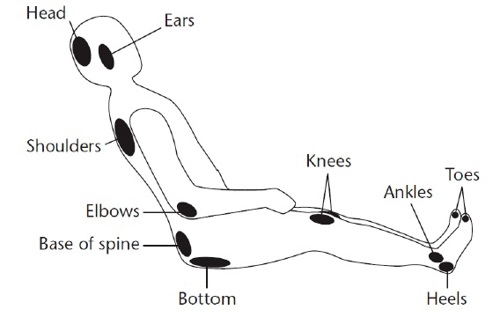
The most important thing to do to avoid a pressure ulcer is to follow the practical advice in the SSKINS checklist below:
SSKINS stands for:
S - skin
S - surface
K - keep moving
I - incontinence
N - nutrition.
S - self care or shared care
SSKINS Checklist
Skin
- Check your skin for signs of damage at least twice a day. Once before getting up and once later in the day but could be before you go to bed at night
- You may find using a mirror is helpful to see areas of your skin, or ask the help of your carer
- Pay particular attention to skin under equipment (such as splints, casts, specialist footwear, body braces). Signs of damage to look out for include; redness or darkness of the skin, blistering or broken skin
- If your skin is discoloured or broken try not to lie or sit on these.
Keep the skin clean and dry. Pat dry after washing. - Do not rub or massage the skin
- Do not use talcum powder or perfumed toiletries.
Surface
- You can place pillows in between your ankles and knees when in bed
- Various aids, cushions and mattresses are available to help redistribute the pressure. A healthcare professional can discuss these with you
- Use lightweight duvet or blankets on your bed
- Avoid clothes and sheets made of synthetic materials. Natural materials such as cotton help reduce sweating and friction.
Keep moving (if able to do so)
- The more mobile you are the better. Change your position regularly when in bed and sitting
- Position changes can be simple. For example, moving from one buttock to another when sitting or moving from your back to lie on your side when in bed
- If the person you are caring for cannot change their own position, you can use aids to help with this. Ask a healthcare professional for advice
- It is important to keep active; small changes to your lifestyle can make a big difference, such as getting up and making a cup of tea when the adverts are on when watching television.
Incontinence
- If you have any issues with your bladder or bowels please ask a healthcare professional for help and advice. (When you are at home this could be your District Nurse. If you are in hospital, then ask the ward staff.)
- Change incontinence pads and clean the skin as soon as possible when wet or soiled
- Apply a barrier cream if a healthcare professional advises you.
Nutrition and Hydration
- Eat a healthy diet. Eating small meals often can be better if you are unable to eat large meals
- Drinks and foods with added calories or protein are
available. If you need these then please speak to your GP. Drinking up to 8 glasses or cups of fluid per day will keep your skin hydrated. Drinks can include tea and coffee but not alcohol.
Self Care or Shared Care
- If you are at risk of getting a pressure ulcer, it is important that everyone involved in your care is aware of what
makes you at risk. You all need to recognise the risks and make any of the necessary changes - If you have diabetes or problems with circulation to your legs and feet, then it is important that you and your carers recognise you are at a greater risk because of these medical problems.
If your skin changes colour or becomes blistered or broken contact a healthcare professional as soon as possible and follow the advice on this webpage.
Carers:
The person you are looking after may need help to check their skin because the areas where pressure ulcers tend to develop are difficult to see.
If you are looking after someone who cannot eat a normal diet, ask your GP for advice.
If you are looking after someone who has bladder or bowel issues and cannot look after themselves, it is important that their skin is kept clean and dry.
Eating To Feel Better
Nourishing Food Advice - Improving Nutrition
It can be worrying if you go off your food or start to lose weight.
This leaflet gives you ideas on how to improve your food intake by making some changes to what you eat and drink. This can make you feel better and prevent further weight loss.
Remember: Not eating can make your appetite worse
If you continue to have problems eating or drinking, contact
your G.P. or Health Professional.
General Advice and Tips
- Aim for 3 small meals and 3 snacks per day
- Use 1 pint of full cream milk daily
- Include a pudding daily
- Buy in foods that you enjoy
- Ask for assistance with cooking where possible
- Share cooking and eating at mealtimes with family and
friends if possible - Try using a company that delivers meals directly to your
door or do your shopping online - Include some fruit and vegetables e.g. fresh, tinned fruit
or frozen - Keep a store cupboard with food such as soups, instant
puddings and tinned fruits.
Ideas for Improving Food and Fluid Intake
It is not advised to take the high sugar foods marked with *
regularly if you have diabetes.
If you have been advised to follow a Modified Texture Diet or
Thickened Fluids, continue to take the correct consistency
when fortifying foods and drinks (use thickeners as advised).
Suggested Food and Drink Ideas
- Porridge or cereal like cornflakes or Weetabix with full-fat
milk and added sugar*, honey* or golden syrup* - Toast with butter/spread and jam*, marmalade*,
peanut butter, chocolate spread*, scrambled egg or
spreading cheese - Full fat yogurts, try adding fresh or stewed fruits
- Pancakes or pastries, with added jam* and butter
- Casseroles or stews, made using meats or beans with potatoes
and vegetables - Spaghetti Bolognese or lasagne with added grated cheese
- Cauliflower or macaroni cheese or canned ravioli
- ‘Boil in the Bag’, frozen or oven ready fish with sauce,
vegetables and waffles or creamed potatoes - Jacket potatoes – various toppings. Add extra cheese, butter
or mayonnaise.
- Sandwich with cold meat, egg, cheese, bacon or
tuna mayonnaise - Sausage roll or pork pie with beans
- Toast with scrambled egg, cheese, canned spaghetti, baked
beans, canned fish, peanut butter or pate - Omelette or quiche.
- Soup served with a buttered roll or sandwich, choose
creamier varieties - Canned fruit with cream or ice-cream
- Individual pots of custard, rice pudding, mousse or trifle
- Crème caramel, cheesecake or instant whips
- Cake or tart with custard or cream.
- Malt loaf/fruit bread/tea cakes with butter
- Scone with jam* and butter, with milky drink
- Biscuits with butter and cheese, shortbread* or
chocolate biscuits* - Crisps or breadsticks with dips, peanuts or mixed nuts
with raisins.
Aim for 6 to 8 cups per day. Drinks before meals can fill you up –
drinking after meals is often best
- Soups or coffee (made with milk), Ovaltine or hot chocolate
- Complan or Meritene type drinks can be useful
- Choose fruit juice or diluting juice with added vitamin C
- Milkshakes (recipe below).
Homemade Milkshake (300kcal, 17g protein)
- 200ml (1/3 pint) full fat milk
- 20g (4-5 teaspoons) milkshake powder
- 30g (6 teaspoons) dried milk powder
Put milkshake powder and dried milk powder into a glass, adding milk gradually, stir well and serve.
Power of Attorney Information
A power of attorney (PoA) is a written document giving someone else authority to take actions or make decisions on your behalf. This could be to deal with your financial affairs and / or welfare matters. It could be used in the future if you become incapable of doing so.
The PoA details the names of the people, known as attorneys, who you want to help you, and lists the individual powers that you want them to have. The PoA will also state when your attorneys can begin acting.
Frequently Asked Questions (FAQs)
Anyone over the age of 16 can make a PoA, but there are restrictions if you have been made bankrupt. See our website for more information.
Your capacity could be impaired gradually or suddenly as a result of an accident or illness. A registered and licensed medical doctor will be able to say whether you are incapable or not.
No one has an automatic right to take actions on your behalf without legal authority. If you are unable to make decisions about your affairs, your family or friends may have to go to court to get the authority to act on your behalf.
No, nobody likes to think that they may not be able to look after themselves but accidents or illness can happen to anyone.
No, it is not just about looking after money/property it can also let you plan who should decide personal welfare issues for you.
You can appoint anyone you want, over the age of 16. This could be a family member or a friend, a solicitor or accountant, or a combination. It’s usually a good idea to have more than one attorney or maybe what is called a substitute attorney to step in if your attorney can no longer do things for you.
You can appoint someone to deal with your financial matters and someone different to deal with your personal welfare.
It is good practice to discuss with the person you want to be your attorney what being an attorney actually involves. It will be helpful if you keep a note of the matters discussed and give your prospective attorney a copy too. Although, it’s your choice who to appoint, you cannot appoint someone who is currently declared as bankrupt to deal with your financial and property affairs.
Any local solicitor should be able to assist you to draft a PoA and provide legal advice on the matter. Alternatively, some companies and stationery shops sell PoA packs. Useful information is also available from our website.
A professional may charge you to draw up a PoA and prices vary. The PoA should include a certificate signed by a practising solicitor or medical doctor. The certificate is needed to confirm that you are capable of understanding the PoA. You might be charged a fee for this service.
We also charge a registration fee. You can find out more about our current fees on our website or phone us.
The PoA must be registered with us before it can be used, even if you are still capable of doing things for yourself.
The following documents need to be sent to us to register your PoA:
- Your signed PoA, including the fully completed certificate
- Confirmation that your attorney/s are freely willing to act on your behalf
- Registration fee.
You can send your documents to us by post or submit your PoA electronically using the electronic PoA registration (EPOAR) facility. Step-by-step guidance is available on our website.
Once the PoA is registered, your documentation and an authentic copy of the PoA along with a certificate will be returned to the sender. We also send you a copy of the registered PoA for your records.
Yes, they can help you with your finances if you want them to do so but they cannot make decisions about your welfare until you are no longer able to make those decisions for yourself.
Attorneys acting on your behalf have a duty to keep records of their actions. This means that continuing attorneys i.e. attorneys with financial related powers should keep an ongoing financial accounting in relation to your property and financial matters. Welfare attorneys should keep records relating to your welfare issues. Guidance is provided in the Code of Practice.
You can cancel your PoA or any of the powers granted in it once it has been registered with us. Information is available from our website explaining how to do this.
Your local Citizens Advice Bureau or solicitor may be able to help. There is lots of useful information on our website or you can phone us if you prefer. Our office is open to the public. However to be sure of seeing a relevant member of staff when you visit us, please contact us to make an appointment.
Address:
Office of the Public Guardian (Scotland)
Hadrian House
Callendar Business Park
Callendar Road
FALKIRK, FK1 1XR
Telephone: 01324 678300
Email: opg@scotcourts.gov.uk
Visit the Office of the Public Guardian in Scotland website.
Opening hours: 9am - 5pm Monday to Friday
How the NHS handles your personal health information
Under the Data Protection Act 1998, you have a right to know who holds personal information about you. This person or organization is called the data controller. In the NHS, the data controller is usually your local NHS Board and your GP surgery.
- Your personal health information is information which identifies you. The NHS must keep your personal health information confidential. It is your right
- Your personal health information is kept in records. Your health records contain information about health and any care or treatment you have received. Records can be written on paper, held on computer, or both
- NHS staff use your information to give you the care and treatment you need. They add to your health records every time you get care or treatment
- Your information may be shared with other people involved in your care
- Sometimes the NHS uses relevant information about your health to help improve the general public's health and NHS services, or to check that money has been spent properly. Wherever possible, information that identifies you is removed
- Apart from very few exceptions provided by the Law, if health data which identifies you is used for teaching or research, you will be asked to provide permission
Sometimes your health information will be shared with people outside the NHS who need it so they can give you care and treatment - for example with a home help or a social worker - but only information that is relevant for your care - Usually the NHS will not share your personal information with people - for example with a relative, carer or friend, without your permission
- Sometimes the law allows the NHS to share your personal health information without your permission, for example to investigate a serious crime or to protect a child or vulnerable adult from harm
- If you are concerned about your information being shared, you should tell a member of NHS staff involved in your care. If there is no need for sharing your information, you can object.
The NHS is continually improving the organisational and security measures in line with best practices, in particular the ISO27001 Standard. This is regularly audited. All NHS staff, subcontractors and partners are trained on how to safely handle your information.
The NHS will only share your personal health information in a lawful and fair manner.
- You have the right to see or have a copy of your health records
- If you want to do this, write to the practice manager at your GP surgery or the records manager at the hospital or other NHS organisation that holds your records
- You may have to pay to see your records, but you don't need to give a reason for wanting to see them
- If you are not happy with anything written in your records, speak to a member of NHS staff providing your care.
For more information
The following materials give you more information about your right to confidentiality and your right to see your health records:
- Confidentiality: how the NHS protects your personal health information (factsheet)
- How to see your health records (leaflet).
You can get these leaflets from GPs and dental surgeries, hospitals and other places where you get NHS care. You can also ask your local NHS Board for a copy; phone the NHS inform Helpline on 0800 22 44 88; or look on the information governance webpage.